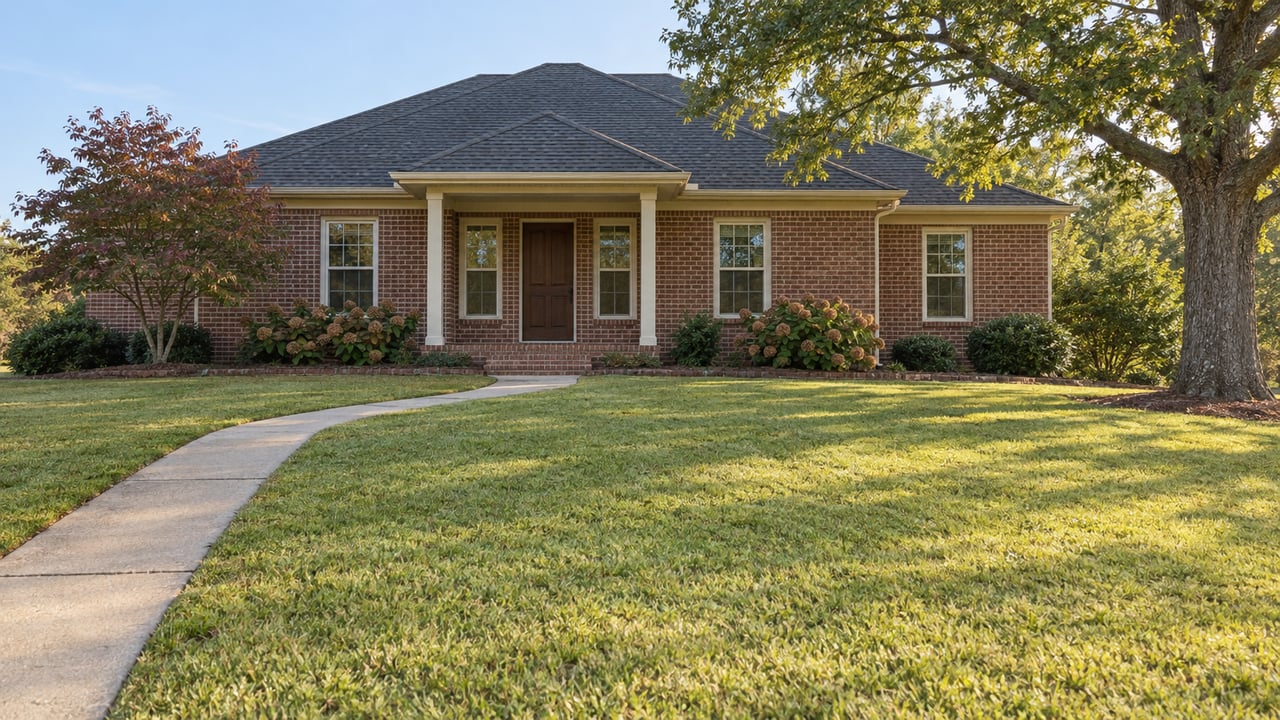
Fortson vs. North Columbus: Property Tax Homestead Exemptions
October 15, 2026
October 15, 2026
When you're comparing a home in Fortson with one a few miles south in north Columbus, the property tax line on the listing is the least useful number in front of you. It shows the seller's exemptions and the seller's assessment history, and on both sides of the Harris–Muscogee line that history ends when the deed changes hands. What matters more for the long run is the rule that takes over once you file your own homestead exemption. Harris County and Columbus use different rules.
In early 2025, Georgia's local governments had to decide whether to take part in the new statewide floating homestead exemption created by House Bill 581. The Georgia Secretary of State's list of opt-outs received by the deadline includes "Columbus / Muscogee County" and the "Muscogee County Board of Education," both received February 19, 2025. Neither Harris County nor the Harris County Board of Education is on that list, which means both stayed in by not opting out.
So a house in Fortson, which sits in unincorporated Harris County, and a house in north Columbus can sell for similar prices and still be assessed under different rules for as long as you own them.
On either side of the line, the seller's tax situation is not something you inherit.
In Muscogee County, the Columbus Tax Assessors' office says a homestead exemption renews automatically each year "unless the owner moves, there is a change of ownership, or the taxpayer seeks to qualify for a different kind of exemption." In Harris County, the floating exemption under HB 581 doesn't carry over to the next owner either. A buyer who qualifies has to apply for their own.
HB 581 also changed something that applies across Georgia. It says "the transaction amount of the most recent arm's length, bona fide sale in any year shall be the maximum allowable fair market value for the next taxable year." Your purchase price becomes the ceiling on the county's fair market value for the following tax year. From there, the two counties take over in different ways.
Muscogee County has had its own local homestead assessment freeze for a long time, and the Georgia Department of Revenue lists Muscogee among the jurisdictions with a local valuation freeze. As the Columbus Ledger-Enquirer explained during the 2025 opt-out debate, a frozen homestead means "a property's value is locked into place the year it becomes a homestead, with the assessed value being 40% of the fair market value of that year." After that, the value goes up only if significant additions are made to the property.
The freeze has limits. According to the Columbus Tax Assessors' homestead page, it applies to the maintenance and operation portion of the millage set by the county and the school board, plus the state levy. It doesn't apply to millage levied to retire bond debt. The same page lists the standard exemption as $2,000 off the state portion and $13,500 off the local assessed value.
For a buyer, the year you claim the homestead sets the number you'll live with. The Ledger-Enquirer's own example shows why. A home homesteaded in 2019 at a $280,000 value carried a frozen assessed value of $112,000. Under the floating approach, that same property's base would have been its 2024 assessed value, $160,000. The longer a seller has held a freeze, the further their assessment can drift below market value, and a buyer starts over at the current value.
Columbus officials did not say the freeze was their reason for opting out. In WRBL's coverage of the council discussion, the concerns raised were revenue stability in a downturn, implementation complexity and staffing, and local control. City attorney Clifton Fay told the council that HB 581 would not adversely affect Muscogee's local freeze.
Harris County homesteads work differently. Under HB 581, the base year is the assessed value from the tax year just before the exemption is first granted. Each year after that, the adjusted base can rise by no more than the prior adjusted base times the inflation rate, plus assessed value added by qualifying substantial changes to the property. The Georgia Department of Revenue's 2026 inflationary index bulletin, issued January 13, 2026, set that rate at 2.7% for the 2026 digest year.
The floating exemption can also move down. Chief appraiser Suzanne Widenhouse told Columbus Council that a floating value could drop for a year after serious property damage from a fire, storm or demolition, while a frozen value would stay put. She estimated that about 1,100 Columbus properties fit that situation at the time, as the Ledger-Enquirer reported.
Here are the two systems side by side:
| North Columbus, Muscogee County | Fortson, unincorporated Harris County | |
|---|---|---|
| Status under HB 581 | Opted out, filed Feb. 19, 2025 | Did not opt out |
| How the homestead assessment behaves | Frozen at 40% of fair market value in the year it becomes your homestead | Floats from a base year, with annual increases capped |
| What can raise it | Significant additions | The inflation index, 2.7% for 2026, plus qualifying substantial changes |
| Seller's exemption after a sale | Ends at change of ownership | Doesn't transfer to the buyer |
| Levies covered | M&O for county, school board and state; not bond millage | Per HB 581 terms |
Assessed value is one input to a tax bill. The millage rate applied to it is the other. Harris County's tax rates page lists 2026 millage of 9.13 for Harris County and 18.5 for the Harris County Board of Education. The Columbus Consolidated Government's five-year levy history lists a net maintenance and operation rate of 15.15 mills for Urban Service Districts 1, 5, 6 and 7 in 2025, with the same rate for 2026 marked "Estimated."
Those figures don't line up as a direct comparison. The Columbus number covers the consolidated government's levy and leaves out the Muscogee County School District's millage. A side-by-side tax estimate for two specific homes needs every levy that applies to each parcel, along with the assessment rules above.
When you can file depends on the county, and it affects how soon your own homestead treatment starts.
This post is general information, not tax or legal advice. Your own exemption eligibility and bill depend on details only the county tax offices or a qualified professional can confirm.
Water and sewer service also change at the county line. Harris County Water Works treats Chattahoochee River water at its 3 MGD plant and serves more than 9,300 customers in the unincorporated county. The department says it provides sewer service exclusively to the Mulberry Grove development, and Columbus Water Works treats that sewage for a fee. For any Fortson home outside Mulberry Grove, find out early how wastewater is handled, because county sewer isn't the provider there.
If the seller's tax bill is low, will mine be too? Not necessarily. In both counties the seller's exemption ends with the sale, and your assessment starts over under your own filing.
Can the county assess my new home above what I paid? Under HB 581, the price of the most recent arm's-length sale is the maximum allowable fair market value for the next tax year.
Do the Columbus city government and the school district follow the same rule? Both opted out of HB 581, and the Secretary of State received both filings on February 19, 2025. Widenhouse told the council that each taxing authority could have decided separately.
If you're weighing a home in Fortson against one in north Columbus, I'm glad to go through the tax and utility details for each specific address with you before you make an offer. Lisa Raines works on both sides of the Harris–Muscogee line and can help you see what changes after closing. Let's Connect.
Stay up to date on the latest real estate trends.

I am dedicated to professional and personalized service to market your property for sale or help you find the home of your dreams to purchase!

100 Brookstone Centre Pkwy Ste A, Columbus, GA 31904